


WOO Global Congress London 2026: First Day Report. How Data, Trust, and Programmatic are Changing the Future of OOH
Last week, I attended the WOO Global Congress London 2026, the largest annual gathering of the Out of Home (OOH) industry worldwide. This event brings together media owners, advertisers, agencies, technology providers, and industry organizations to discuss the future of outdoor advertising and the development directions of the entire market.
This year's edition gathered a record number of participants – over 800 delegates from 55 countries. Already after the first day, I had the impression that regardless of the topic of individual presentations, they all led to a similar conclusion: the future of OOH will be based on trust, data, and increasingly deep integration with the digital ecosystem.
OOH is growing. But the industry wants to grow faster.
The Congress was opened by Tom Goddard, President of WOO.
He presented impressive figures. The global Out of Home market reached a value of $54 billion in 2025, growing by 15% year-on-year. Already almost half of this revenue comes from Digital Out of Home (DOOH), which shows that the digital transformation of outdoor advertising has become one of the main drivers of growth for the entire market.
At the same time, Goddard made it clear that the industry does not intend to celebrate its successes and rest on its laurels.
WOO is currently focusing on four areas: effectiveness measurement, audience data, integration with adtech, and actively building OOH's competitive advantages.
This last point resonated particularly strongly throughout the day.
OOH remains a medium present in the real world, and at the same time, one of the most trusted advertising channels. In times of growing problems with the quality of parts of the digital environment, this is an argument we should not underestimate.
Jean-François Decaux: It's time to stop reacting and start anticipating changes!
One of the most interesting presentations of the day was by Jean-François Decaux.
This was not a presentation about JCDecaux's successes. Quite the opposite. Decaux focused primarily on the challenges facing the industry.
He spoke about increasing regulatory restrictions on advertising, initiatives aimed at limiting the presence of commercial communication in public spaces, and the need to actively build the social value of OOH.
He also devoted much attention to the changes occurring in media planning.
According to the data he cited, in the coming years, the vast majority of purchasing decisions will be supported or made by algorithms.
For the OOH industry, this means a very simple conclusion: if we want to be included in the campaign planning process, we must be present where these algorithms operate. Integration with programmatic OOH platforms is no longer an add-on to the offering. It is becoming a prerequisite for further development and presence in the modern media buying ecosystem.
Advertisers Expect Data and Measurable OOH Campaign Results
Matt Green's presentation from the World Federation of Advertisers was also very interesting.
His message can be summarized in one sentence: advertisers increasingly expect proof, not promises.
The pressure to demonstrate business results is growing in practically all markets. Budgets are increasingly allocated to channels that can show their impact on sales, traffic, or other specific marketing goals.
This is also an important signal for OOH.
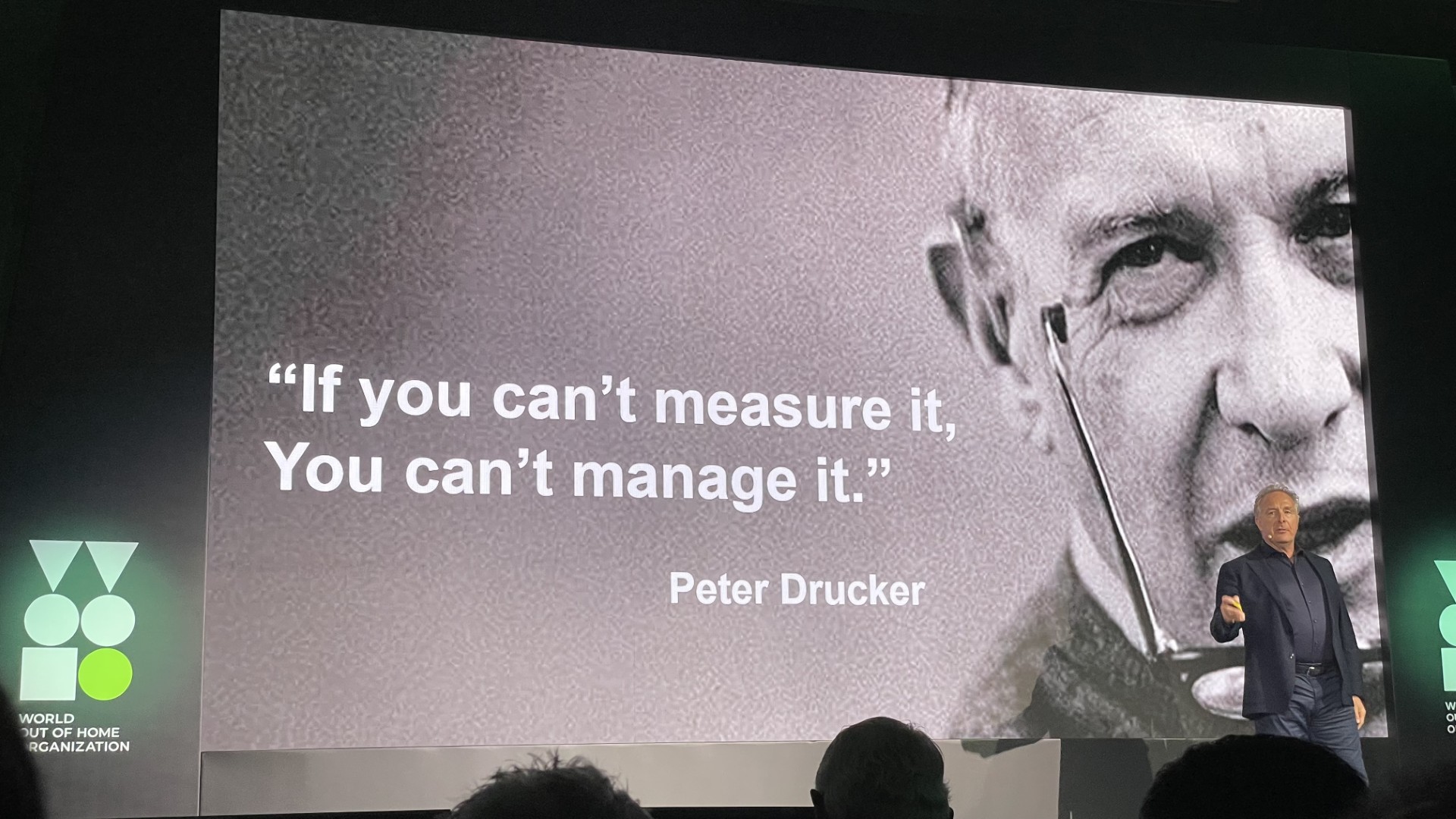
Reach alone is no longer a sufficient argument. OOH campaign effectiveness measurement, data analysis, and the ability to demonstrate the real impact of campaigns on an advertiser's business results are becoming increasingly important.
"Why IRL Media Wins the Next Decade" – The Most Impactful Presentation of the First Day
If I had to pick one presentation that generated the most enthusiasm in the room, it would be Nick Brien's from OUTFRONT.
His main thesis was very simple – trust is becoming one of the most valuable currencies in advertising, and OOH is one of the few media that can consistently build it.
Nick Brien showed data indicating a decline in trust in many forms of digital advertising. The reasons are well known: an excess of messages, problems with content quality, privacy issues, and user fatigue from constant targeting.
Against this backdrop, Out of Home advertising performs exceptionally well. It is perceived as a more credible, safe, and naturally present medium in the everyday environment of audiences. Moreover, it also positively influences the perception of brands themselves.
However, his most interesting observation concerned the change taking place in marketing.
For years, we operated in an "Attention Economy", where the most important thing was to capture the user's attention.
According to Brien, we are increasingly entering the era of the "Action Economy", where what matters is not just whether someone saw an ad, but primarily whether it prompted them to act.
And this is where OOH – a medium operating in the real world – can have a natural advantage.
Three Key Takeaways After the First Day of WOO Global Congress 2026
Returning to the hotel in the evening, I had three main observations in mind.
Firstly, a narrative based on trust is becoming one of OOH's strongest selling points.
Secondly, integration with the programmatic ecosystem is no longer an option. In a world of increasingly automated media planning, it is simply a necessity.
Thirdly, advertisers will increasingly expect not only audience data but also proof of campaign impact on business.
After the first day of the WOO Global Congress London 2026, it's hard to shake the impression that the Out of Home industry is entering another stage of development. It will not be based solely on new screens or technologies, but primarily on trust, data quality, effectiveness measurement, and integration with the programmatic ecosystem. These were the key issues discussed on the first day of the congress. There are many indications that they will define the development of outdoor advertising in the coming years.
Jet Line Commentary
If you are interested in how the OOH industry has changed over the past few years, we also invite you to read Michał's text from last year's WOO congress. You will find many observations there that are even more relevant today. Outdoor Advertising - Breakthrough Directions