


WOO Global Congress London 2026 - Day Two: Data, M&A, and Regulations

After the first day of the congress (WOO Global Congress London 2026), one could get the impression that the most frequently used word was "trust."
On the second day, three other topics came to the forefront: audience measurement, money, and regulations.
Seemingly very different issues. In practice, they all come down to one question: how to increase OOH's share in global advertising budgets?
Audience Measurement Is No Longer Optional
Friday morning presented congress participants with a difficult choice. Three thematic tracks ran simultaneously: programmatic DOOH, retail media, and audience measurement.
I chose the latter.
The reason was simple. For several years, I've observed that audience data is becoming one of the most important sales arguments in our industry. Without credible measurement, it's difficult today to discuss campaign effectiveness, let alone increasing budgets.
The session was opened by Gideon Adey, presenting the new version of the WOO Global Guidelines for OOH Audience Measurement document.
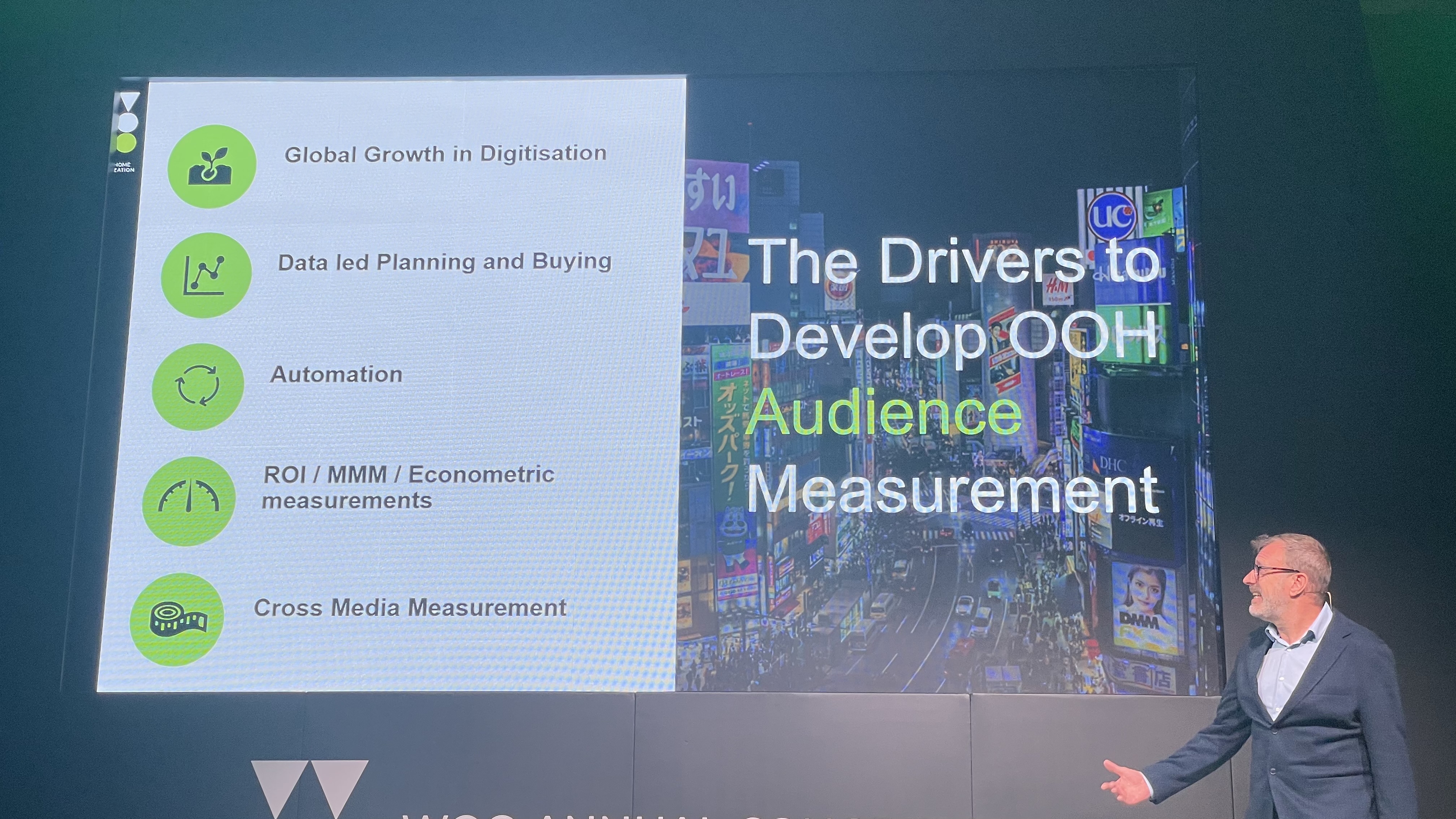
The most interesting part, however, was not what changed in the guidelines themselves, but the direction the entire industry is heading.
Data on measuring individual ad impressions, post-campaign analysis, and the integration of OOH with MMM models and cross-media measurement are playing an increasingly important role.
In practice, this means that OOH is increasingly no longer evaluated solely by its own metrics. It's beginning to be compared with TV, digital, audio, or CTV within a single measurement ecosystem.
The panel with representatives from Australia, the UK, New Zealand, the US, and Japan was also very interesting.
Despite differences between markets, all presentations led to a similar conclusion: the future of OOH requires common standards, greater transparency, and better proof of campaign effectiveness.
OOH Is Attracting Increasing Capital
One of the most anticipated presentations of the day was Mark Boidman's from Solomon Partners.
If the first day of the congress was primarily about the industry's future, Boidman showed how investors value that future.
And they're valuing it increasingly higher.
The list of transactions from recent months was impressive. Clear Channel's acquisition by Mubadala for $6.2 billion, Broadsign's growth after acquiring Place Exchange, investments in retail media, and further private equity transactions show that OOH is now seen as an attractive and resilient asset class.
Two trends highlighted by Boidman were particularly interesting.
The first is the development of proprietary content ecosystems built by brands. More and more companies are producing their own content, which then needs to find its way to audiences. According to Boidman, OOH is a natural distribution channel for such content.
The second trend is the explosion of retail media.
Just a few years ago, most retail chains earned almost exclusively from product sales. Today, they're increasingly discovering that advertising can be one of the most profitable elements of their business.
As a result, stores are rapidly transforming into media.
New screens, electronic shelf labels, sensors at shelves, and proprietary retail media networks are becoming standard in the world's largest retail chains.
For OOH operators, this is an important signal. The boundaries between the worlds of OOH, DOOH, and retail media are beginning to blur.
Regulations: Time to Go on the Offensive
The last session I attended was a panel on regulations.
It's a less spectacular topic than AI, programmatic, or multi-billion dollar acquisitions, but it may prove equally important for the industry's future.
The panelists showed the scale of restrictions that OOH faces today in various markets. Bans on advertising certain product categories, restrictions on DOOH, climate arguments, citizen initiatives, and local urban planning regulations are becoming everyday reality in many countries.
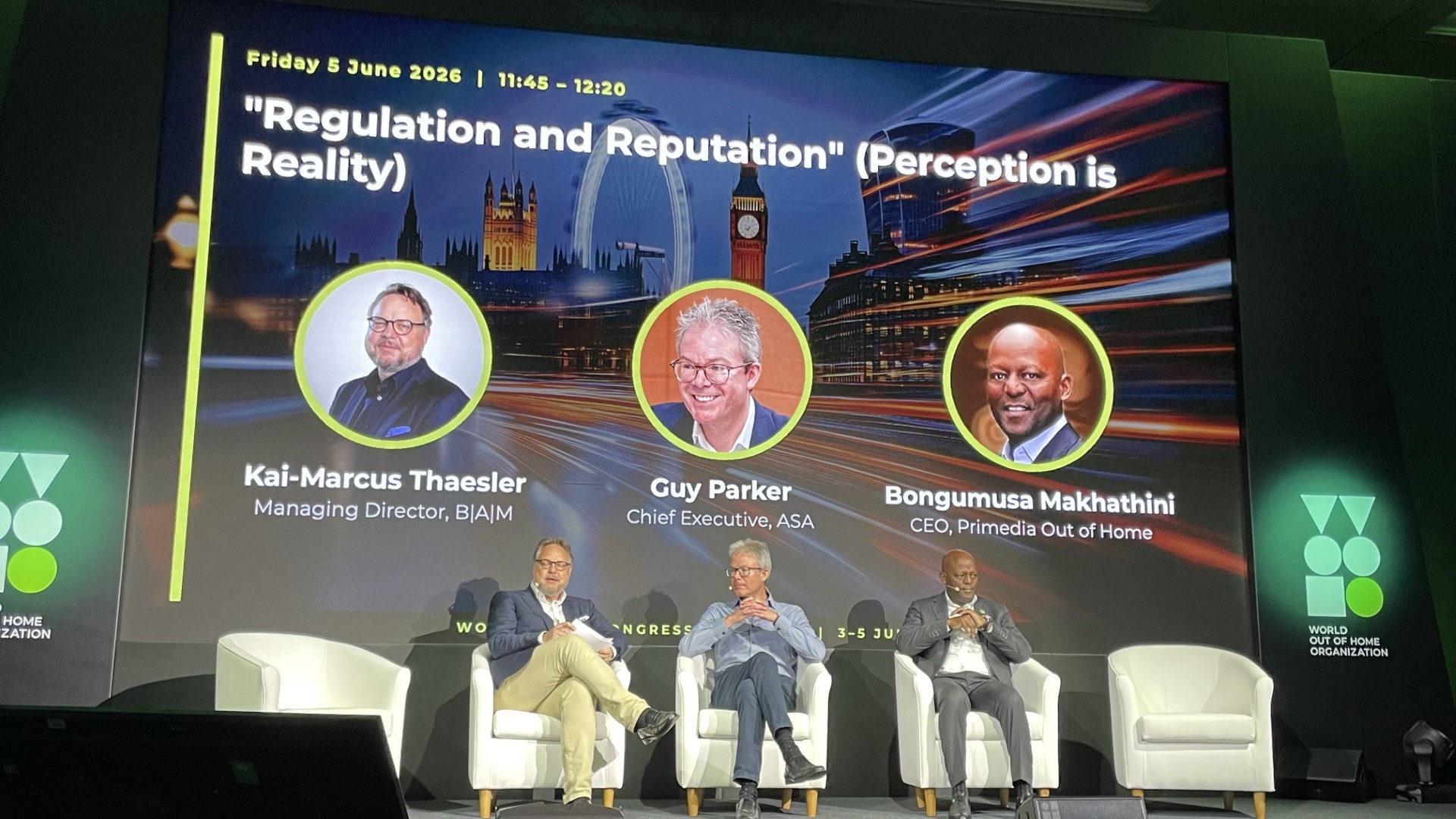
The OOH industry can no longer limit itself to reacting to successive threats. It must act earlier.
WOO announced the creation of a global cooperation system in the area of regulations, knowledge exchange, and monitoring of new legislative initiatives.
This is a good direction.
In a world where perception often becomes reality, building a positive image of OOH as a responsible, valuable, and community-beneficial medium is just as important as winning legal disputes.
Three Takeaways After Day Two
Returning from the congress, I had the feeling that all three sessions were talking about the same thing, just from different perspectives.
Audience measurement is meant to help advertisers better evaluate campaign effectiveness.
Capital flowing into OOH shows that investors believe in the industry's continued growth.
And regulatory actions are meant to secure the conditions for this growth in the coming years.
After two days of the London congress, it's increasingly clear that the future of OOH will depend not only on screens and locations.
Data, technological integration, credible measurement, and the ability to prove value to both advertisers and regulators will become increasingly important.
And it's precisely around these topics that the most important discussion in the global OOH industry is taking place today.